POLYTEC PASSION CREATES INNOVATION

Future-proof through sustainable practices

WIE POLYTEC NACHHALTIGKEIT ZUR STÄRKE MACHT

POLYTEC exemplifies that processing plastics does not have to conflict with environmental protection. In addition to resource-friendly processes and energy-efficient ­production procedures, the company also meets increasing ecological standards by ­developing ­recyclable products. For the CO2 emissions at the company’s production sites, the ­declared goal is climate neutrality by 2035 for Scope 1 and 2.

Sustainability is not a buzzword for ­POLYTEC, but a clear commitment – to the future and, above all, also to its customers. When developing policies, measures and targets, the company therefore not only takes the applicable statutory provisions into account but also attaches central importance to customers’ sustainability requirements. 

Please read our detailed Sustainability Statement 2025


SUSTAINABILITY STATEMENT 2025

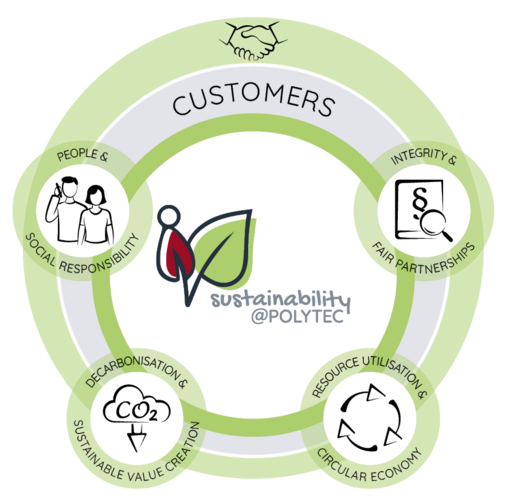
With its four strategy fields for sustainability, POLYTEC not only meets its obligations in terms of sustainability, but also clearly addresses the specific requirements placed on the company by customers.

Reporting in accordance with CSRD

In the past, POLYTEC organised its sustainability activities in eight strategy fields with three defined focus fields: People, Energy and Production. In the past financial year, the sustainability strategy was harmonised with the European Corporate Sustainability Reporting Directive (CSRD), which was further specified in 2025. POLYTEC thus aligned its sustainability strategy with the legally required European Sustainability Reporting Standards (ESRS).

Within the three ESG areas, environment (E), social matters (S) and ­governance (G), the following four core topics were identified based on a double materiality analysis, and policies, measures and targets were established or further developed: E1 Climate change, E5 Resource use and circular economy, S1 Own workforce and G1 Business conduct. Additional areas could potentially be integrated into the strategy in the future. With clear targets, policies and metrics, POLYTEC makes the impact of its measures visible and manageable. In doing so, the group did not have to ­reinvent its sustainability reporting, but was able to build on existing structures, which were efficiently adapted to the ESRS.

ESRS E1


Climate change


Strategy field “Decarbonisation & Sustainable Value Creation”
 

.We make our value creation sustainable – through ­meaningful ­decarbonisation ­measures, the use of ­renewable ­energy, and responsible ­management of our supply chains.

MORE

ESRS E5


Resource use and 
circular economy


Strategy field “Resource Use & ­Circular Economy”
 

We make an active ­contribution to resource conservation and promote the circularity of our products and ­processes.

MORE

ESRS S1


Own workforce


Strategy field “People & 
Social Responsibility”


We promote a work environment that gives people a sense of ­purpose and ­motivates them to ­contribute ­actively and ­responsibly – for a fair, healthy and ­equitable workplace that ­empowers ­everyone.

MORE

ESRS G1


Business conduct


Strategy field “Integrity & 
Fair Partnerships”


We foster a culture of openness and responsibility – with clear rules, protected reporting paths and fair partnerships on equal terms.

MMORE

ESRS E1

Climate change

Strategy field “Decarbonisation & Sustainable Value Creation”

With its active contribution to climate change mitigation, POLYTEC also aims to ensure the company’s long-term sustainability. The measures bundled in the strategy field “Decarbonisation & Sustainable Value Creation” comprise integrative and risk-based concepts for decarbonisation, for expanding energy production from renewable sources, and for promoting sustainable procurement processes in order to enable the company to respond promptly to changes in regulatory requirements and market conditions. Based on measures to increase energy efficiency, the aim is to save electricity and gas and to minimise both the company’s own emissions and those from purchased energy (Scope 1 and 2), and from purchased goods as well as services and transport (Scope 3). The specific targets and measures have been defined in the POLYTEC GROUP’s path to decarbonisation (see page 50). This strategy field forms the foundation of corporate responsibility – towards the environment, society and the expectations of customers, suppliers and investors. POLYTEC thus shows that the focus is not only on climate goals, but rather on responsible business operations along the entire value chain.

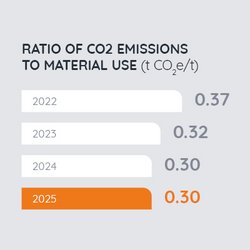
VRATIO OF CO2 EMISSIONS TO MATERIAL USE (t CO2e/t)

As further production sites switched to green electricity, the POLYTEC GROUP recorded a substantial decline in CO2 emissions of 26.7 percent (Scope1 and 2) in 2025 com­pared to the previous year. In contrast, emissions remained unchanged in relation to significantly less material used.

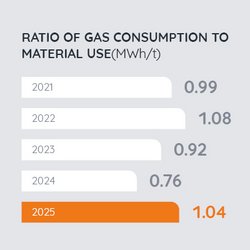
Verhältnis Gasverbrauch zu Materialeinsatz (MWh/t)

Der Gasverbrauch im Verhältnis zum eingesetzten Material lag deutlich über dem Vorjahreswert. Hauptauslöser dafür war ein deutlicher Rückgang des Materialeinsatzes für Produkte, die ohne den Einsatz von Gas erzeugt werden. Obwohl der Grundverbrauch an Gas leicht zurückging, verzerrte sich damit das Verhältnis der beiden Berechnungsgrößen.

The comparative figures stated only have limited significance due to shifts in the portfolio. 

Markus Huemer

We are taking ­deliberate steps to further advance ­decarbonisation – for example, by using green electricity. At the same time, however, we ­always ensure that our sustainability initiatives are economically viable.

Markus Huemer
CEO

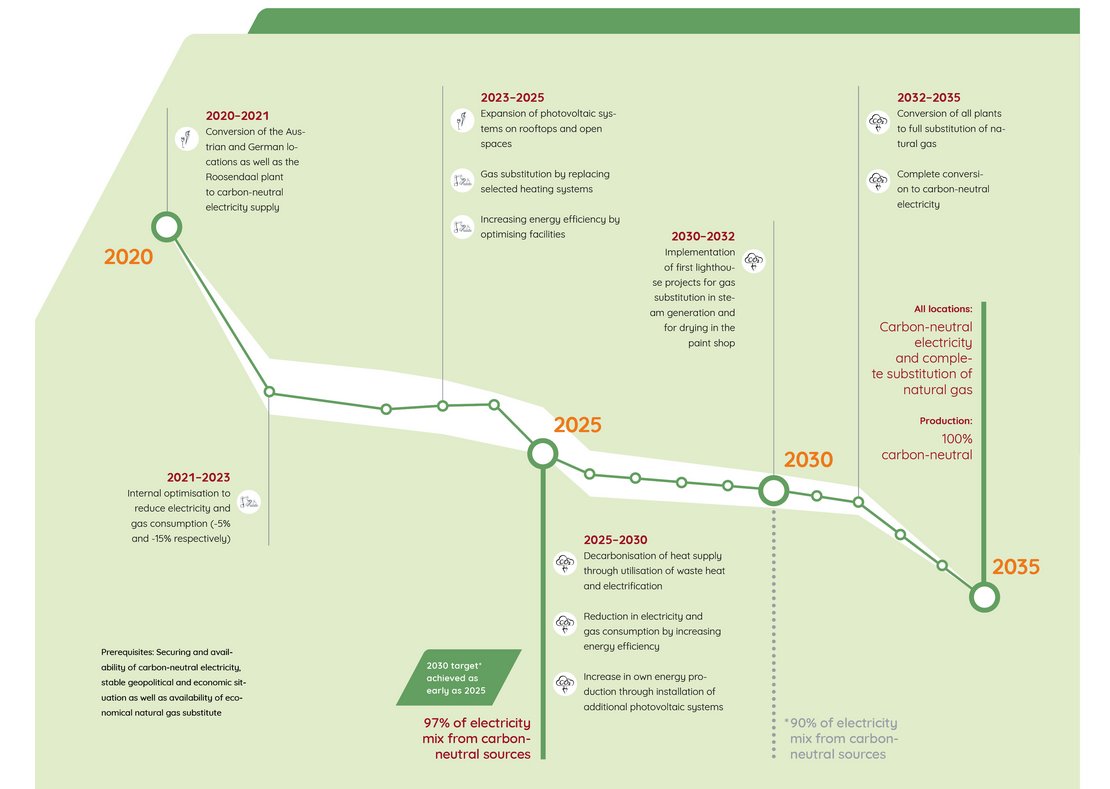
Go Neutral 2035
The POLYTEC GROUP’s path to decarbonisation
 

As part of the “Go Neutral 2035” initiative, the POLYTEC GROUP pursues a decarbonisation path with concrete and measurable results. The overarch­ing goal is to fully neutralise all Scope 1 and Scope 2 emissions from ­production across the group.
 

In the 2025 financial year, the POLYTEC GROUP aligned its sustainability reporting to the requirements of the European Corporate Sustainability Reporting Directive (CSRD). For ­further information, please go to page 44. This was based on the double materiality analysis, which was first carried out in 2024 and updated in 2025.

Measures in connection with climate-damaging emissions were considered to be particularly relevant in the materiality analysis. This is why POLYTEC continued to drive efficiency measures, energy savings and the conversion to carbon-neutral electricity. As a result, almost 2,000 megawatt hours of energy were saved in 2025. CO2 emissions were also reduced through the increasing utilisation of green electricity, which is now used in all European plants. Moreover, the expansion of the company’s own photovoltaic systems boosts its energy independence and contributes to lowering costs in the long term and to increasing security of supply.

By integrating the new CSRD standards, POLYTEC provides the basis for effective control of climate-related risks and opportunities – and underlines its clear path towards climate neutrality by 2035.

In 2025, the POLYTEC GROUP’s CO2 emissions (Scope 1 and Scope 2) were roughly 27 percent lower than in the 2024 financial year, with revenue remaining at a ­similar level. The comparison with 2020 shows a decline by ­approximately 62 percent, while revenue increased by about 20 percent.

ESRS E5

Resource use and circular economy

Strategy field “Resource Use & Circular Economy”

POLYTEC focuses on efficient resource use, waste reduction and promoting closed-loop material cycles in order to make the production of plastic-based products as sustainable as possible. Specifically, the company drives material recycling, supports proper waste separation and consistently increases the recycled content in material used. In doing so, risks related to raw material procurement and disposal are also taken into account. The measures bundled in the strategy field “Resource Use & Circular Economy” cover the entire value chain, making an active contribution not only to resource conservation and environmental relief, but also to safeguarding value chains in the long term. All company sites with relevant material use are incorporated in these measures. As a result, this strategy field is a central part of POLYTEC’s commitment to ecological responsibility and sustainable business operations.

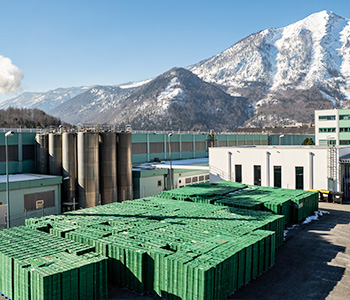
At POLYTEC‘s location in Ebensee, used logistics boxes made of plastic have been recycled on a large scale since 2022.

ESRS S1

Own workforce

Strategy field “People & Social Responsibility”

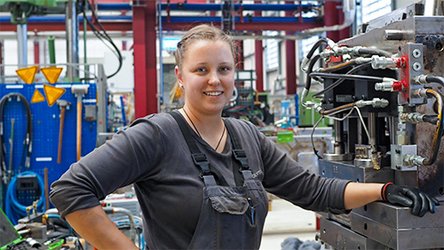
Motivation, health, expertise and loyalty of employees are key prerequisites for POLYTEC’s successful transformation and innovative strength. This is why the strategy field “People & Social Responsibility” focuses on a fair, safe and attractive working environment, in which people can develop and thrive in the long term – regardless of gender, origin or life situation.

Special attention is currently paid to equal opportunity for women, who are often underrepresented in the automotive and plastics industries. ­Measures ­include, among other things, the promotion of equal pay. In addition to increasing health and safety, another key strategic goal is improving employee turnover – because strong employee retention not only contributes to safeguarding know-how in the company but also reduces costs and increases stability in operations.

Satisfied and motivated employees form the basis for the ­POLYTEC GROUP’s innovative strength and long-term ­economic success.

ESRS G1

Business conduct

Strategy field “Integrity & Fair Partnerships”

For POLYTEC, ethical business conduct and collaborative business practices are the linchpin of a corporate culture that actively embraces openness, responsibility and fairness. These principles are clearly defined in the strategy field “Integrity & Fair Partnerships”. Long-term partnerships and fair business practices strengthen trust and shape collaboration on a sustained basis. Codes, policies and targeted training for employees are used to preventively counter potential legal violations. Easily accessible structures for whistleblower protection ensure that violations are addressed openly, fairly and transparently. A permanently monitored whistleblowing portal and measurable key figures ensure compliance with company standards.

POLYTEC holds comprehensive staff training to prevent violations of compliance regulations.